The New Suzuki e VITARA: Is 2026 the Year to Go Electric?
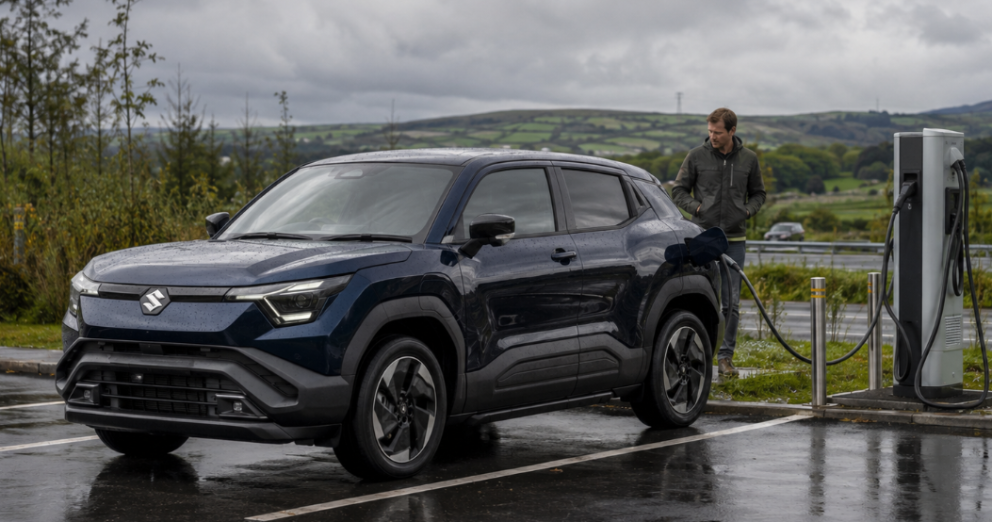
For many Irish drivers, the move to an electric car has gone from “maybe someday” to a genuine question: is now the right time to make the switch?
The new Suzuki e VITARA makes that decision particularly interesting. Suzuki’s first fully electric SUV combines the familiar practicality of the Vitara Suzuki name with electric driving, modern technology, and a choice of battery packs and drivetrain options, including front wheel drive and the advanced ALLGRIP-e all-wheel-drive system with trail mode for off-road capability.
But is the Suzuki e VITARA 2026 really suited to life in Ireland? What about the price, charging, Irish weather, Dublin traffic, longer motorway journeys, and safety features?
At Gerry Caffrey Motors in Terenure, we know that choosing an electric vehicle isn’t simply about range figures on a brochure. It’s about how the car fits into your daily life, including comfort, practicality, and driver assistance technologies like adaptive cruise control and traffic sign recognition.
What Is the Suzuki e VITARA?
The Suzuki e VITARA is the brand’s first fully electric production car, bringing the Vitara name into the electric SUV market with zero emissions and fewer moving parts than traditional combustion engines.
It has been designed as a practical compact SUV rather than an electric car that feels completely unfamiliar. That should make the transition easier for existing Suzuki owners and drivers who like the size, raised driving position, and spacious cabin of a Vitara.
In Ireland, the e VITARA is available with two battery options and drivetrain combinations. The 49kWh smaller battery 2WD model produces up to 106kW (144 hp) and achieves 0-100 km/h in 9.6 seconds, while the 61kWh bigger battery 2WD version increases output to 128kW (174 hp) with a 0-100 km/h time of 8.7 seconds. The 61kWh ALLGRIP-e four-wheel-drive (AWD) model produces up to 135kW (183 hp) and 307Nm of maximum torque, accelerating from 0-100 km/h in just 7.4 seconds.
The rear seats slide forward by up to 160mm and recline for added practicality, allowing a flexible balance between passenger legroom and boot space, which ranges from 244 litres to 310 litres with the seats slid forward. The rear axle and suspension have been tuned for ride comfort and stability, though some road noise and wind noise can be noticeable at motorway speeds.
The e VITARA features a 10.25-inch instrument cluster and a 10.1-inch infotainment screen integrated into a unique floating centre console design. The interior includes 12-colour ambient lighting, physical buttons for air conditioning and other controls, and four cupholders in total, enhancing the cabin's comfort and convenience. The heated steering wheel and heated front seats are standard on models with the bigger battery, while keyless entry, rear parking sensors, and a rear view camera come as standard equipment across trim levels.
Safety is a priority with the e VITARA, which received a four-star Euro NCAP rating and scored 85% in the child occupant category. All models come standard with blind spot monitoring, rear cross-traffic alert, front and rear parking sensors, and advanced driver assistance features like adaptive cruise control, lane keep assist, and an adaptive high beam system.
The e VITARA uses lithium iron-phosphate (LFP) battery packs available in 49kWh and 61kWh sizes, supporting DC fast charging at 70kW and AC charging at 11kW for convenient and flexible charging options.
Built on the dedicated Heartect-e EV platform developed with Toyota, the e VITARA incorporates efficient electric motors and inverter units called eAxles, contributing to its smooth performance and off-road capabilities.
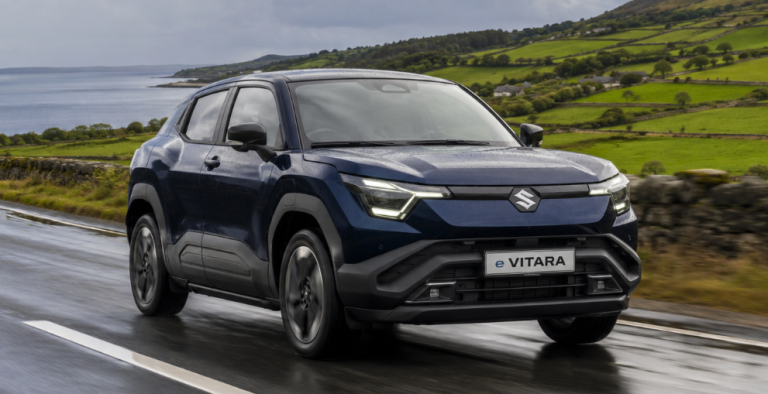
Compact dimensions make the e VITARA well-suited for urban driving, while its rugged SUV styling and the ALLGRIP-e electric four-wheel-drive system enhance its capability on rough terrain, positioning it competitively against other compact electric SUVs like the Skoda Elroq, Kia EV3, and Hyundai Kona Electric.
The Suzuki e VITARA is an excellent choice for families seeking a compact, practical electric crossover with a strong safety profile and modern technology.
Suzuki e VITARA 2026: What Does It Cost in Ireland?
One of the biggest questions for anyone researching an electric SUV Ireland is price.
Suzuki Cars Ireland currently lists the new Suzuki e VITARA from €32,995, including the maximum applicable SEAI grant and VRT relief. The range also includes higher-spec versions, with the 61kWh Ultra trim listed from €40,470, which adds features like a panoramic sunroof with retractable sunshade, premium Infinity audio system, and a power-adjustable driver's seat.
The top-spec Allgrip-e model costs €44,055, featuring the AWD system and additional premium features.
That makes the e VITARA worth considering alongside conventional hybrid SUVs rather than viewing it purely as a premium electric vehicle.
For comparison, the current Suzuki range includes the mild-hybrid Vitara from €28,995 and S-Cross from €30,995, while the Swift starts from €22,495.
e VITARA Price Ireland: Don't Forget the Government Incentives
Electric-car pricing in Ireland can be confusing because the advertised price may take government incentives into account.
Revenue currently states that qualifying new fully electric passenger vehicles registered before 31 December 2026 can receive VRT relief of up to €5,000, subject to the vehicle’s Open Market Selling Price. Relief is reduced above €40,000 and removed above €50,000.
That means anyone looking at the e VITARA price Ireland should check the exact model, specification, and registration date rather than relying on a headline figure alone.
Government incentives and tax rules can change, so it’s sensible to check the latest information before ordering.
Is the e VITARA Practical for Dublin Driving?
This is where the e VITARA makes a strong case.
Dublin driving can mean everything from stop-start traffic on the M50 to tight residential streets in South Dublin. Add in supermarket car parks, school runs, and short journeys, and a compact SUV can make a lot of sense.
The e VITARA's electric drivetrain is particularly well suited to urban driving. Electric motors deliver their maximum torque immediately, making pulling away at junctions and moving through traffic smooth and responsive. The steering wheel is designed with a modern two-spoke shape that provides a clear view of the 10.25-inch instrument cluster and the road ahead.
And there’s no clutch or conventional gear-changing to think about.
In our experience, drivers moving from smaller cars often want the higher seating position and extra practicality of an SUV without moving into something physically huge. That’s one of the reasons models such as the Suzuki Vitara and S-Cross continue to appeal to Irish drivers.
The e VITARA takes that familiar formula and removes the petrol engine altogether.
The compact dimensions of the e VITARA make it particularly suitable for urban driving, allowing easy manoeuvrability and parking in tight city spaces.
What About Irish Weather and Electric Range?
Irish weather deserves more attention than it sometimes gets in discussions about electric cars.
Cold temperatures, heavy rain, wind, traffic, and the use of air conditioning or demisting systems can all affect real-world EV efficiency. Suzuki itself notes that charging times can vary depending on factors including ambient temperature, battery temperature, battery condition, and state of charge.
The e VITARA offers two battery options using lithium iron phosphate (LFP) blade cells, known for their stability and longevity: a smaller 49kWh battery providing an official maximum range of 344 km, and a bigger 61kWh battery offering up to 426 km in the front wheel drive model.
That doesn't mean an electric car isn't suitable for Ireland.
It means buyers should choose a battery size and charging routine based on their actual driving rather than simply looking at the biggest possible range number.
If most of your driving is around Dublin and South Dublin, overnight home charging can make everyday EV ownership remarkably straightforward. You can start many mornings with the battery fully charged rather than making a weekly trip to a filling station.
For longer journeys, you'll want to plan charging stops in advance.
How Quickly Can the Suzuki e VITARA Charge?
Charging speed is another important part of the electric-car equation.
Suzuki states that the e VITARA can charge from 10% to 80% in around 45 minutes when using a suitable 70kW or higher rapid DC charger. Actual charging times will vary depending on conditions and the charging infrastructure available.
The e VITARA supports 11kW AC charging, allowing faster charging at many public and destination chargers, while home charging typically uses 7kW single-phase wallboxes.
For everyday Dublin driving, however, you may rarely need rapid charging.
If you can charge at home, overnight charging can cover the majority of regular commuting and local journeys. Public rapid charging becomes more relevant for longer trips around Ireland.
That distinction is worth remembering when comparing an electric car with a petrol or hybrid.
Should You Choose 49kWh or 61kWh?
The answer depends on how you drive.
The 49kWh e VITARA is the entry point and could make sense for drivers whose daily mileage is relatively modest and who have convenient access to home charging.
The 61kWh version provides greater battery capacity and may be more attractive if you regularly travel longer distances or simply want more flexibility between charging sessions.
Then there’s the 61kWh ALLGRIP-e model.
For drivers in rural areas or anyone who regularly encounters poor weather and challenging road conditions, four wheel drive can be an attractive option. Suzuki’s ALLGRIP-e electronically controlled dual-motor all wheel drive system enhances traction and stability, with selectable AUTO and TRAIL modes for different terrain.
It’s also worth remembering that Irish roads can vary dramatically between a dry summer motorway and a wet, muddy rural lane in January.
e VITARA vs Suzuki Vitara: Which Should You Buy?
This is likely to be one of the most common questions for Suzuki buyers in 2026.
The conventional Suzuki Vitara remains a strong choice for drivers who want SUV practicality, hybrid technology, and the convenience of a petrol-powered car.
The e VITARA, meanwhile, is designed for drivers who are ready to make the move to fully electric.
That doesn't make one automatically better than the other.
Choose the e VITARA if:
- You want to reduce your reliance on petrol.
- You prefer smooth, quiet electric driving with fewer moving parts.
- You want a fully electric SUV with zero emissions.
- Most of your driving is local or regional.
- You can charge conveniently at home or work.
The Vitara may suit you better if:
- You’re looking for maximum value from the current hybrid range.
- You prefer the familiarity of a conventional refuelling routine.
- You want the flexibility of a petrol-hybrid powertrain.
- Home charging isn't practical.
- You regularly undertake long journeys without planned charging stops.
The important thing is to match the car to your lifestyle rather than buying purely because one powertrain is newer.
What About the Suzuki S-Cross and Swift?
The e VITARA isn't replacing every other Suzuki.
The Suzuki Swift remains an excellent option for drivers who spend most of their time in Dublin and want something compact, economical, and easy to park. At the other end of the SUV spectrum, the S-Cross offers additional family practicality while retaining relatively compact dimensions for Irish roads.
At Gerry Caffrey Motors, we often see customers comparing several Suzuki models before making a decision.
That's a good approach.
A customer who initially arrives looking at an e VITARA may discover that a Vitara hybrid, S-Cross, or even Swift makes more sense once we discuss mileage, parking, family requirements, charging, and budget.
You can explore the Suzuki Vitara range at Gerry Caffrey Motors and Suzuki S-Cross range before arranging a test drive.
New vs Used: Does Electric Change the Equation?
Not every Irish driver needs to buy brand new.
Used Suzuki cars can offer an attractive route into the brand, particularly for buyers who want to keep the purchase price under control.
If you're considering changing from an older petrol or diesel car, it's worth comparing the total running costs rather than simply looking at the monthly repayment.
A newer electric vehicle may offer different running costs, but a quality used Suzuki could provide a lower initial purchase price and familiar ownership experience.
At Gerry Caffrey Motors, we regularly help customers compare new and used options and assess the value of their current vehicle as a trade-in.
That can be particularly useful when moving into an electric car because your existing car's trade-in value can make a significant difference to the amount you need to finance.
Suzuki e VITARA Finance and Trade-Ins
For many buyers, the question isn't simply “Can I afford an e VITARA?”
It’s “What would my monthly payment look like after my deposit and trade-in?”
Suzuki Ireland currently advertises 0% APR representative finance on selected e VITARA models, including a 49kWh Motion example at €295 per month over 37 months, subject to the stated terms, deposit, and lending criteria.
Finance offers can change, so always check the latest terms before making a decision.
You can also explore Suzuki finance options or speak directly to the GCM team about your current car and potential trade-in.
What About the NCT?
Buying an electric car doesn't mean escaping the NCT.
Once the vehicle reaches the relevant age, it will still need to meet Ireland's roadworthiness requirements. The electric drivetrain itself has fewer traditional engine components, but tyres, brakes, suspension, lights, steering, and other safety-related components still matter.
For used-car buyers, service history and condition remain just as important as they are with a petrol or hybrid vehicle.
A well-maintained Suzuki with a clear history is always preferable to buying based purely on a low advertised price.
Is 2026 the Year to Go Electric?
For some Irish drivers, absolutely.
The case for switching becomes particularly strong if you have home charging, a predictable daily commute, and most of your journeys fall comfortably within the car's practical range.
The calculation is different if you regularly drive long distances at short notice or don't have access to convenient charging.
That's why we wouldn't tell every customer that an electric car is automatically the right choice.
Instead, we'd look at how you actually drive.
If you're commuting from Terenure to Dublin city centre five days a week, doing the school run, and occasionally heading to Wicklow, an EV could fit your lifestyle extremely well. If you're regularly driving from Dublin to Donegal or Cork with little opportunity to charge, your priorities may be different.
Why the e VITARA Could Be a Smart First Suzuki Electric Car
Suzuki isn't trying to reinvent what makes a practical family car useful.
The e VITARA keeps the compact SUV format that Irish drivers already understand, then adds a fully electric powertrain.
You still get the raised driving position, SUV styling, modern technology, and everyday usability. The cabin includes physical buttons for air conditioning, keyless entry, rear parking sensors, and a rear view camera, enhancing convenience.
The major difference is what happens when you press the accelerator.
Instead of a petrol engine building revs and changing gears, the electric motor delivers smooth and immediate power with an impressive level of control.
For someone considering their first Suzuki electric car, that familiarity could be one of the e VITARA's biggest strengths.
The Bottom Line for Irish Drivers
The Suzuki e VITARA 2026 arrives at an interesting point in the Irish car market.
Electric vehicles are becoming increasingly normal, charging infrastructure continues to develop, and buyers have more choice than they did even a few years ago.
The e VITARA gives Suzuki customers another option without forcing them into a dramatically different type of vehicle.
For Dublin and South Dublin drivers who can charge at home, regularly drive shorter distances, and want the advantages of electric motoring with adaptive cruise control, blind spot monitoring, and an adaptive high beam system, it's certainly worth putting on the test-drive list.
But if you're still unsure, don't overlook the rest of the Suzuki range. The Swift, Vitara, and S-Cross each offer different advantages, and the right choice depends on your driving life.
If you're researching electric cars Ireland or thinking about changing your current Suzuki, the best next step is to experience the difference for yourself.
Thinking about upgrading to a Suzuki? Visit Gerry Caffrey Motors in Terenure, Dublin 6W. Our team can talk you through the e VITARA, compare it with the Vitara, Swift and S-Cross, discuss finance and value your current car for trade-in.