That Flashing Traction-Control Light — What Is Your Car Actually Doing?
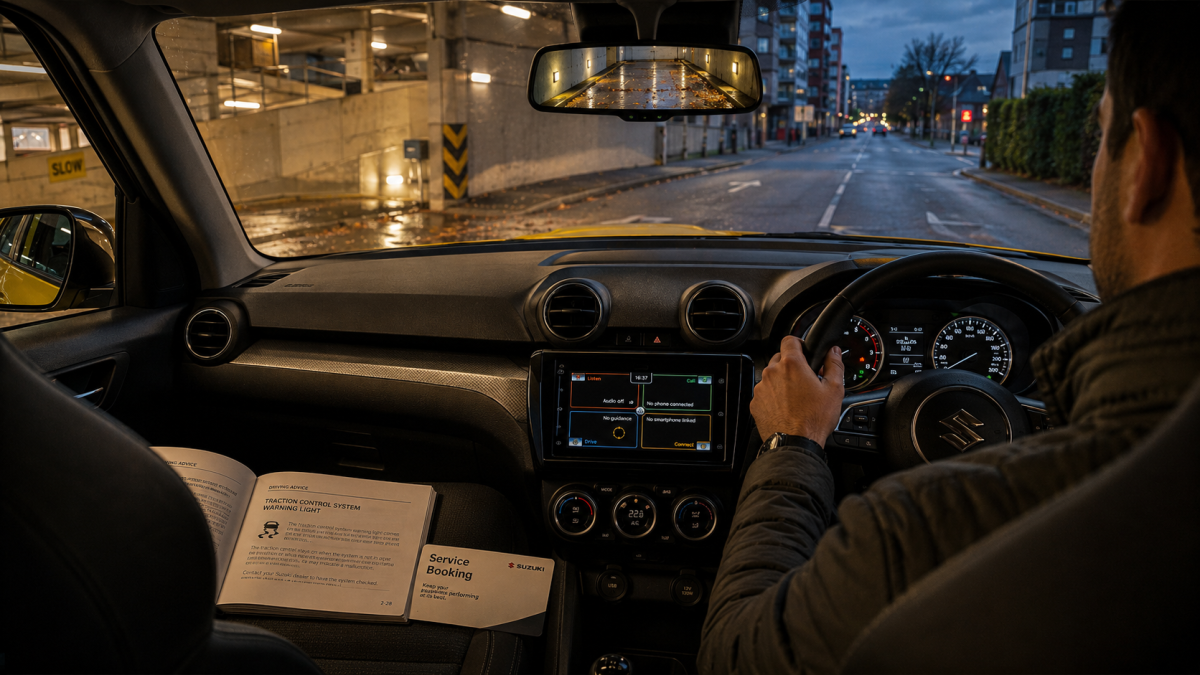
You pull away from a junction on a wet Dublin morning and, for half a second, a small amber symbol flashes on the dashboard. It looks like a car leaving two wavy lines behind it.
Did something go wrong? Usually, no. A flashing traction-control light normally means your car has spotted wheel slip and is actively helping you regain grip, preventing you from losing traction.
That quick flicker is especially common on wet roads, greasy roundabouts, leaf-covered streets during autumn driving, and other slick conditions. Here’s what’s happening beneath the surface — and when the light does need attention.
What Does the Flashing Traction-Control Light Mean?
In most cars, the skidding-car symbol represents the traction control system, electronic stability control or a combined system often labelled TCS, ESC or ESP.
When the light flashes briefly while you’re driving, the system is intervening. One or more tyres are rotating at a speed the car doesn’t expect, suggesting that grip is starting to disappear. This may happen when one wheel or even two wheels spin at a different speed, indicating a loss of traction.
Suzuki’s own guidance says the ESP indicator can blink when traction control, stability control or ABS control is activated. If it flashes, the important message is simple: drive carefully.
Flashing Light Versus Steady Light
The pattern matters.
- Several warning lights together: Stop somewhere safe and check the owner’s manual, particularly if ABS or brake-system lights are also showing.
- “ESP OFF” or “TCS OFF” illuminated: Traction or stability assistance has been deliberately disabled or is temporarily unavailable.
- Staying on continuously: The system may have been switched off or there may be a fault, possibly a failing sensor or other component.
- Flashing for a moment: The system is working because it has detected slip or instability.
Car dashboard lights vary between models and model years, so your handbook is the final word. If a warning stays on after restarting the car, book a diagnostic check rather than assuming it’ll clear itself.
What Is the Traction Control System Actually Doing?
Your car uses wheel-speed sensors to monitor how quickly each wheel is turning. Those sensors are also used by systems such as ABS and electronic stability control.
Imagine you accelerate away from traffic lights on wet road paint or snowy conditions. One driven wheel begins spinning faster than the others because the tyre can’t transfer all the engine’s power to the ground.
The car recognises that difference in milliseconds. Depending on the vehicle, it may:
- Reduce engine torque to limit the amount of power sent to the slipping wheel or wheels;
- adjust throttle response to provide more power to the wheels with grip;
- alter ignition or fuel delivery; or
- apply a small amount of braking to the slipping wheel or tyre losing grip, especially if it is on a different axle.
You might feel a brief hesitation through the accelerator, hear a light pulsing or notice the engine revs settle. That’s normally the traction control system managing wheel slip — not the engine losing power at random.
Electronic stability control goes a step further. It compares your steering input with the direction the car is actually travelling, then can brake individual wheels and reduce power to help keep the vehicle on your intended path.
The technology is fast, but it can’t rewrite the laws of physics. It won’t create grip where the tyres have none, and it can’t make an unsafe speed safe.
Traction control works by monitoring the speed of each wheel and detecting when one or more wheels are spinning faster than others. This spinning wheel or wheels indicate a loss of grip or traction loss, often occurring on slippery road surfaces like icy roads, snowy conditions, or slick conditions.
The system’s control logic then intervenes to limit power to the slipping wheel or wheels. It does this by reducing engine output or applying brake force selectively, helping to prevent the vehicle from sliding sideways or losing control.
In many vehicles, the traction control system is integrated with the ABS light system, sharing sensors and control logic to maintain vehicle stability.
During cornering, traction control can help mitigate understeer and oversteer by adjusting power and braking to individual wheels, thus maintaining better control and reducing the chance of the vehicle sliding sideways.
This is especially important when the vehicle’s differential allows the wheels on one axle to rotate at different speeds, which can otherwise lead to one wheel spinning freely and losing traction.
Why It Flashes More Often on Wet Irish Roads
South Dublin drivers don’t need a dramatic snowstorm to see the traction light. Ordinary Irish weather provides plenty of low-grip moments.
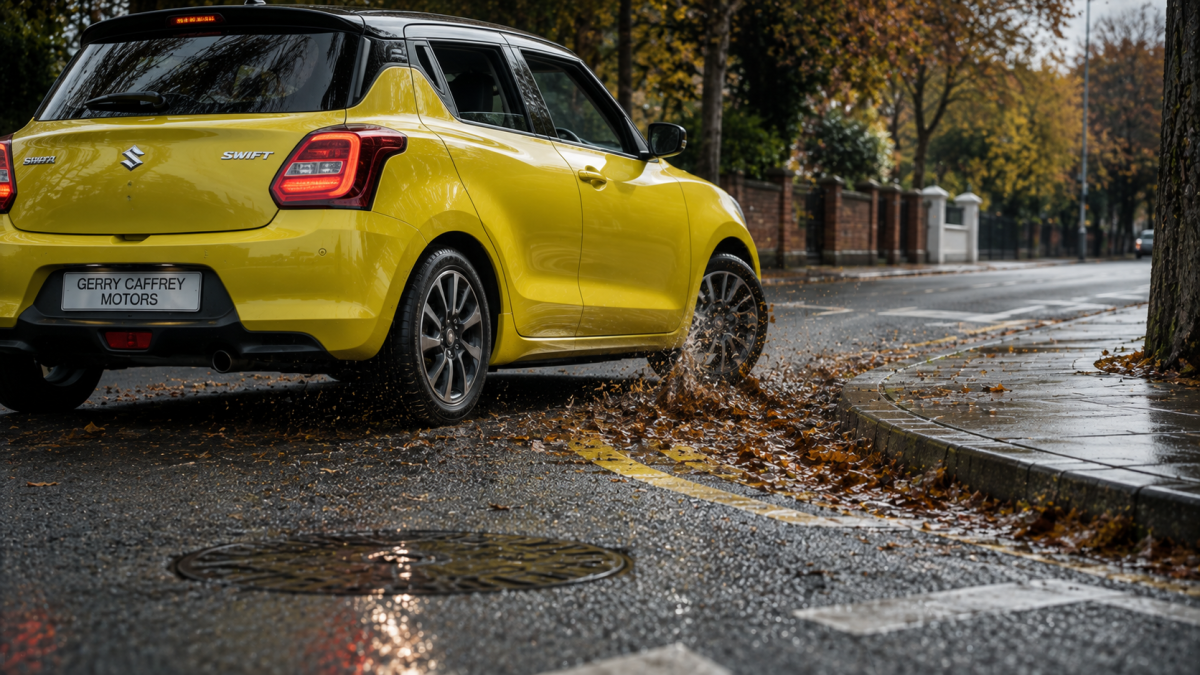
We often see the system activate on shiny road markings, metal manhole covers, loose gravel, wet leaves, or when driving off road.
A steep car-park ramp or a brisk pull-out onto a busy road can be enough too.
Common triggers include:
- Heavy rain and standing water;
- damp leaves breaking up under the tyres;
- diesel residue and grime after a dry spell;
- painted bus-lane markings and pedestrian crossings;
- worn, damaged or incorrectly inflated tyres;
- accelerating too sharply while the steering wheel is turned;
- limited-slip differentials that manage power distribution between wheels;
- and driving on icy roads or in snowy conditions.
Autumn driving can be particularly deceptive. A road may look merely damp, yet leaf mulch and cool temperatures can leave far less grip than you expect around Terenure, Rathfarnham or the tree-lined roads of Dublin 6W.
Is It the Same as Aquaplaning?
Not quite.
Wheel slip under acceleration happens when a driven tyre spins faster than the road speed. Aquaplaning happens when a tyre can’t clear water quickly enough and begins riding on a film of water.
Traction control may react to the changing wheel speeds, but it can’t guarantee control during aquaplaning. Ease off the accelerator, keep the steering smooth and avoid sudden braking or sharp inputs until the tyres regain contact with the ground.
What Should You Do When the Light Flashes?
Treat the flash as useful feedback. The car is telling you that the available grip is lower than your current acceleration or steering demand.
Ease the accelerator gently and keep your steering inputs smooth. Increase the distance to the vehicle ahead, particularly on faster routes such as the M50, N11 or wet dual carriageways.
Don’t panic and don’t stamp on the brakes simply because the light has appeared. Look well ahead, reduce speed progressively and give the tyres time to settle.
If it happens once while pulling away on a slippery patch, that’s usually normal. If it flashes repeatedly on a straight, dry road during gentle driving, something deserves investigation.
When Repeated Flashing Could Point to a Problem
Frequent intervention isn’t always an electronic fault. Often, it’s the system exposing a mechanical or tyre-related issue.
In our experience, the first checks should be straightforward:
- Tyre pressures: Compare all four with the manufacturer’s figures, usually shown in the handbook or on a door-jamb label.
- Tread and condition: Look for low tread, uneven wear, cracks, cuts or bulges.
- Matching tyres: Different sizes, constructions or heavily mismatched wear levels can affect grip and wheel-speed readings.
- Wheel alignment: Uneven wear or a car pulling to one side warrants attention.
- Recent wheel or suspension work: A damaged or disturbed wheel-speed sensor can trigger warning lights.
The Road Safety Authority states that tyres must have at least 1.6 mm of tread and recommends at least 3 mm for safety. That limited amount of extra margin matters in Irish rain, where worn tread has less capacity to move water away from the contact patch.
Tyres are also checked during the NCT, but passing the test doesn’t mean you should ignore a recurring traction-control warning. The NCT is a roadworthiness check on the day; it isn’t a substitute for diagnosing an intermittent electronic or sensor fault.
Should You Ever Turn Traction Control Off?
For normal driving on Irish roads, leave it switched on. It’s there to support you when grip changes unexpectedly.
Some manufacturers allow the system to be reduced or switched off temporarily when a vehicle is stuck in snow, mud or loose material and a controlled amount of wheel spin is needed. Follow the handbook for your exact model and switch it back on once you’re moving.
On compatible Suzuki models, ALLGRIP driving modes can also adapt the vehicle’s response to changing surfaces. For example, selected Suzuki Vitara versions offer ALLGRIP with modes designed for different conditions.
That’s useful assistance, but careful speed, smooth inputs and sound tyres still come first.
For a model-specific explanation of the warning symbol, consult your Suzuki owner’s manual. It will explain how the ESP, traction-control and ABS indicators operate on your exact model.
Traction Control When Buying a New or Used Car
Whether you’re considering a Suzuki Swift, Vitara or S-Cross, ask for a proper handover of the driver-assistance systems. You should know what each symbol looks like, when it’s normal for it to flash and which lights require a workshop visit.
A new Suzuki gives you the reassurance of current safety technology and a full dealer handover. A carefully prepared used car can offer excellent value, but tyre condition, warning-light checks, service history and a diagnostic scan are all important.
At Gerry Caffrey Motors, we look at the whole car, not just how it presents on the forecourt. Our new and used stock includes premium used vehicles prepared for Irish roads, alongside the latest Suzuki range.
If you’re comparing an Irish dealer car with an import, remember that the advertised price isn’t the full picture. VRT, Revenue registration requirements and the vehicle’s supporting documents can all affect the true cost and how quickly the car can be put on the road.
A trade-in can make the change simpler, while the right finance structure can help you compare monthly cost as well as purchase price. Gerry Caffrey Motors offers finance options across its new and used vehicle range.
Quick Answers About the Traction-Control Light
Is It Safe to Drive When the Traction-Control Light Flashes?
A brief flash generally means the system is actively responding to reduced grip. Ease off, drive smoothly and adapt your speed to the conditions.
Why Does the Light Flash When I Accelerate?
One or more driven wheels may be starting to spin. This is more likely on wet roads, loose surfaces, worn tyres or when accelerating while turning.
Why Is the Traction-Control Light Staying On?
The system may be switched off, temporarily unavailable or faulty. Check for an “OFF” message, restart the car safely and consult the owner’s manual.
If the light remains on, arrange an inspection.
Can Worn Tyres Make Traction Control Activate More Often?
Yes. Low or uneven tread, incorrect pressures and mismatched tyres can reduce grip or create wheel-speed differences that prompt more intervention.
Does Traction Control Help a Car Pass the NCT?
Traction and stability systems are part of the car’s safety equipment, but an NCT pass doesn’t diagnose every intermittent warning. A persistent light should be checked before the test rather than ignored.
A Flash Is Feedback — Use It
That flashing symbol is usually your car saying, “Grip is getting tight, so I’m stepping in.” Respond by easing off and giving the road conditions more respect.
If the light stays on, appears repeatedly in normal conditions or arrives with other warning lights, have the car checked. A tyre, sensor or stability-system issue is far better dealt with early.
Thinking about upgrading to a Suzuki? Visit Gerry Caffrey Motors in Terenure, Dublin 6W. We’ll help you compare a Swift, Vitara or S-Cross, value your trade-in and find a new or premium used car that suits real Irish driving.