Suzuki e Vitara Ireland: What Changes When You Drive Electric in Autumn?
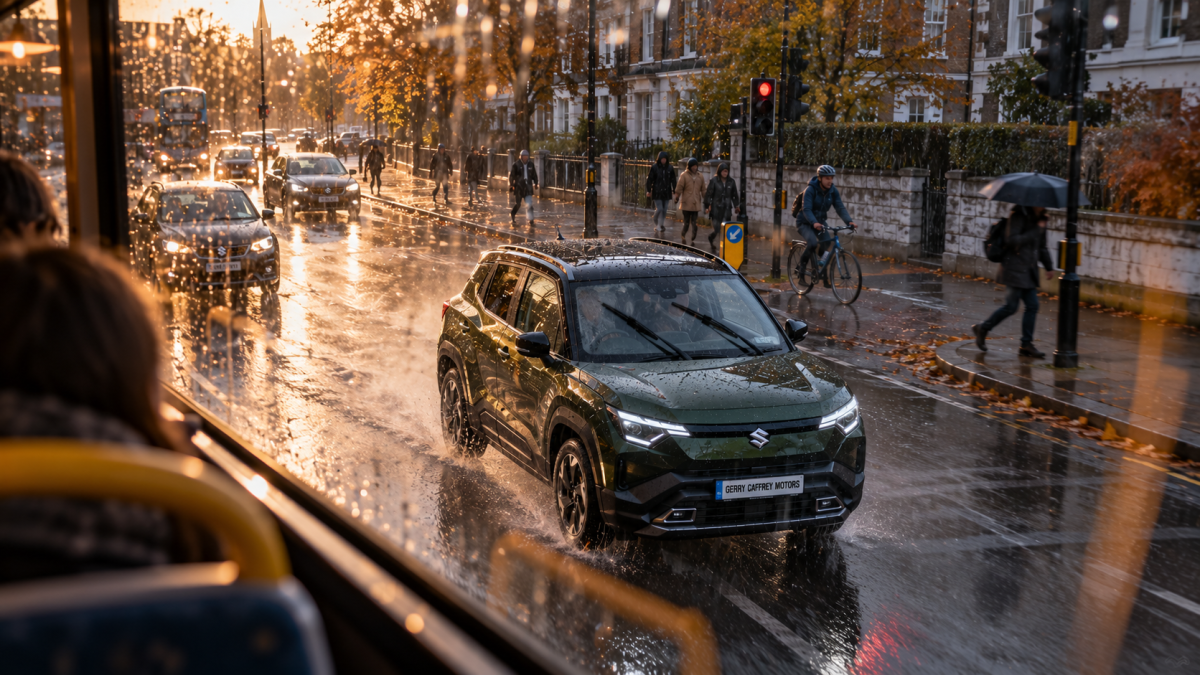

Autumn is when Ireland reminds us just how quickly driving conditions can change.
One minute you’re leaving South Dublin in mild sunshine. The next, the wipers are working overtime, the temperature has dropped and the M50 is covered in spray.
If this is your first autumn driving an electric car, specifically the Suzuki e VITARA Ireland, a fully electric SUV with an elegant design and instant torque, you might be wondering whether anything else needs to change too.
With the new Suzuki e VITARA Ireland, a battery electric vehicle and electric SUV available in Ireland, the answer is: a little. Driving an electric SUV in Ireland brings a few new habits around charging and electric range, but most owners quickly find that everyday electric mobility becomes remarkably normal.
Here’s what to expect from your first Irish autumn behind the wheel.
Your e VITARA Range May Change as the Weather Gets Colder
One of the first things new EV owners notice as temperatures fall is that their estimated electric range can change.
That’s normal.
Battery performance is affected by ambient temperature, while heating the cabin, demisting the windscreen and running other electrical systems also uses power and energy.
The Suzuki e VITARA offers an impressive official WLTP electric range of up to 426km, depending on specification, vehicle load, and other factors. Real life driving results will naturally vary depending on weather, individual driving style, vehicle load, road takes and other factors.
Electric vehicles exceed daily range needs for most drivers, but real life driving results may vary depending on other factors like individual driving style and the road takes.
For most Dublin drivers, the important number isn’t the maximum theoretical range. It’s how much energy your normal routine actually uses.
A commute from South Dublin into the city, school runs around Terenure or Rathfarnham, and weekend trips will soon give you a much better idea of your personal charging requirements.
In our experience with cars tested, new EV drivers often think about range far more during their first few weeks than they do once they’ve settled into an ownership routine.
Cabin Heating Matters More in an Electric Car
In a petrol or diesel car with a combustion engine, heat produced by the engine can be used to warm the cabin.
An electric car works differently, so heating becomes part of your overall energy consumption.
The good news for e VITARA owners is that a heat pump is fitted as standard. It’s designed to heat the cabin efficiently and reduce the demand placed on the battery during colder journeys.
On a wet November morning in Dublin, that matters.
You’ll still want a warm cabin and a clear windscreen. You’ll simply become a little more aware of how heating and other systems can affect the range estimate on the dashboard.
Home Charging Changes the Way You Think About Fuel
Perhaps the biggest adjustment with e VITARA ownership isn’t actually driving the car.
It’s charging it.
You can charge your EV at home using a home charger or wallbox, which allows overnight charging for convenience using mains electricity. Charging from a household socket is possible but slower.
If you can charge at home using a dedicated home charger or wallbox, your routine can become very different from owning a petrol or diesel Suzuki. Instead of watching the fuel gauge and planning a stop at a filling station, you can plug the car in when you get home and have it fully charged and ready for your next journey.
That can be particularly convenient in autumn.
When it’s dark, wet and cold outside, being able to start the morning with charge already in the battery means one less stop on the way to work.
Public charging stations are expanding rapidly across urban areas in Ireland. For longer trips around Ireland, public rapid charging stations become part of your planning. Fast charging stations can charge an EV from 10-80% in about 25 minutes, depending on the charger, ambient temperature, battery temperature, starting charge, and the battery’s existing starting charge.
Wet Irish Roads Reward Smooth EV Driving
Electric vehicles deliver their power differently from conventional petrol and diesel cars.
The response can feel immediate, particularly if you’re moving into an EV or fully electric car for the first time.
That makes smooth accelerator inputs particularly useful when Irish roads become wet, greasy or covered in fallen leaves.
It’s not about driving slowly everywhere. It’s about being progressive.
Give yourself appropriate braking distance, accelerate smoothly and remember that conditions can change considerably between a dry main road and a damp, shaded stretch of a smaller Dublin road.
The e VITARA also offers different driving modes, allowing you to adjust its character to suit the journey and conditions.
Regenerative Braking Takes a Little Getting Used To
Another change for drivers moving from a conventional car with a combustion engine to an electric car in Ireland is regenerative braking.
Electric vehicles can recover energy during braking for efficiency by converting kinetic energy back to battery charge.
When you lift off the accelerator in an EV, the car can recover energy that would otherwise be lost during deceleration and return some of it to the battery.
At first, the sensation may feel different.
After a little time, most drivers naturally begin anticipating traffic and adjusting the accelerator earlier. Dublin traffic gives you plenty of opportunities to practise.
Think of a typical drive through Terenure towards the city centre. You’ll accelerate, slow for traffic, move again and stop repeatedly.
That kind of urban driving is where the characteristics of an electric powertrain can feel particularly natural once you’ve adapted.
Autumn Is a Good Time to Check Your Tyres
Whether you drive a Suzuki Swift, Vitara, S-Cross or the electric e VITARA, tyres become particularly important as autumn arrives.
Irish roads can quickly become slippery with rain, mud and fallen leaves.
Check your tyre pressures regularly and keep an eye on tread depth and general condition. Correct tyre pressures are important for safety, but they can also help an electric vehicle operate efficiently.
We often see drivers focus heavily on the EV battery while forgetting that many of the most important autumn checks are exactly the same as they’ve always been.
Tyres, wipers, lights and windscreen condition still matter.
What About Longer Autumn Trips Around Ireland?
This is where a little planning helps.
A normal week around Dublin may require very little thought once you’ve established a home-charging routine. A longer drive to Galway, Cork or Donegal is different.
Before setting off, check your available range and look at charging options along your route.
You don’t necessarily need to stop every time you see a charger. Instead, build charging into stops you’d probably make anyway.
Coffee. Lunch. A stretch of the legs.
Depending on the version, the e VITARA offers a useful official WLTP impressive range for journeys beyond city and suburban driving.
Remember that WLTP figures are designed for comparability purposes between vehicles tested to the same technical procedures rather than guaranteeing the distance you’ll achieve on every journey. Cold weather, motorway speeds, passenger and luggage loads, and driving style can all influence real life driving results.
Does Driving an Electric SUV in Ireland Cost Less?
Electric vehicles produce zero local CO2 emissions while driving, helping reduce your environmental impact.
Your individual running costs depend heavily on where and when you charge, how many kilometres you cover and your electricity tariff.
Electric vehicles generally have lower running costs than combustion engine vehicles. Charging an electric vehicle is often cheaper than fueling with gasoline or diesel.
Electric vehicles have fewer moving parts, reducing maintenance costs.
Someone doing most of their charging at home can save money and have a very different cost profile from a driver relying heavily on public rapid chargers.
There are also Irish tax rules to consider when buying an EV.
VRT relief and electric vehicle incentives can change, so it’s important to check the latest Revenue rules when purchasing or registering an electric car in Ireland.
The same applies to grants and manufacturer offers. Look at the complete road price and finance package rather than assuming every electric car receives the same incentives.
Do Electric Cars Still Need an NCT?
Yes.
Driving electric doesn’t remove your normal responsibilities as a vehicle owner. An EV is still subject to Ireland’s NCT requirements when applicable.
The test may differ in certain respects from a petrol or diesel vehicle, but areas such as tyres, brakes, steering, suspension, lights and general roadworthiness remain important.
If you’re buying a used electric car in the future, the same principle applies as with any used vehicle: condition and history matter.
e VITARA vs Vitara, Swift and S-Cross: Which Suzuki Fits Your Driving?
Going electric isn’t automatically the right move for every driver.
That’s why it helps to compare the e VITARA with Suzuki’s wider range rather than looking at EV ownership in isolation.
The Suzuki Swift remains an appealing option for drivers who want a compact car that suits urban driving.
The Suzuki Vitara offers familiar SUV practicality, while the S-Cross provides another practical SUV option for families and drivers covering a mix of urban and longer-distance journeys.
The Suzuki e VITARA is the option for drivers ready to move to a fully electric Suzuki SUV with instant torque and an elegant design.
The Suzuki Vitara is a compact SUV available with hybrid technology including plug in hybrid options. It features a 1.4-litre Boosterjet petrol engine with mild-hybrid assistance and achieves fuel economy figures around 5.3 L/100km.
The Suzuki Vitara is equipped with a 9-inch multimedia touchscreen display with smartphone integration.
The standard boot space of the Suzuki Vitara is 375 litres with rear seats up, expanding to a maximum cargo capacity of 642 litres with rear seats folded down.
The optional ALLGRIP 4WD system provides selectable modes for various driving conditions.
The Suzuki Vitara offers a warranty of up to 10 years depending on servicing.
In Ireland, the Suzuki Vitara is priced starting around €28,995, including promotional savings, VRT relief, and pricing correct at the time of sale.
Your mileage, access to charging stations, regular routes and budget should all be part of that decision.
New or Used: Think About Your Whole Cost to Change
Changing cars isn’t simply about the advertised price of the new vehicle.
Your current car has value too.
A trade-in can reduce the amount you need to finance, while different finance structures such as hire purchase agreement or personal contract plans with optional final payment can change your monthly payments considerably.
At Gerry Caffrey Motors, we regularly talk to drivers who arrive expecting to replace like with like and discover that other cars or another Suzuki suits their current driving better.
Someone driving a Vitara today might be ready for an e VITARA. Another customer may decide a new Swift or S-Cross makes more sense.
That conversation is worth having before you make a decision.
Financing Your Suzuki e VITARA in Ireland
We offer flexible finance options through trusted providers including Volkswagen Financial Services Ireland and others, all subject to lending criteria regulated by the Central Bank.
Volkswagen offers leasing options for electric vehicles, and Volkswagen Financial Services provides flexible monthly payment plans with typical APR of 3.9% for electric models.
BMW also offers tailored finance solutions for electric cars, with BMW electric cars having lower ongoing costs than combustion vehicles.
Our team can explain acceptance fees, completion fees, and any additional cost related to accessories fitted post registration or home charger installation.
Transparent pricing correct at the time of sale ensures you know the total cost and road price upfront.
Your First Autumn in an Electric Car Is Mostly About New Habits
After a few weeks, EV autumn driving tends to become less about the technology and more about routine.
You know roughly how much charge your commute uses. You know when it makes sense to plug in. You get used to regenerative braking and you stop checking the range display every few minutes.
And on a cold Dublin morning, getting into a modern electric SUV that’s quiet, smooth and ready to go can make the switch feel very natural.
Thinking about upgrading to a Suzuki? Visit Gerry Caffrey Motors in Terenure, Dublin 6W to take a closer look at the e VITARA, Vitara, Swift and S-Cross. The team can also talk you through current new and used stock, finance options including hire purchase agreement, and the value of your trade-in.
Book your test drive today to experience the benefits of electric mobility firsthand.