Speed Limits - Reducing in 2026
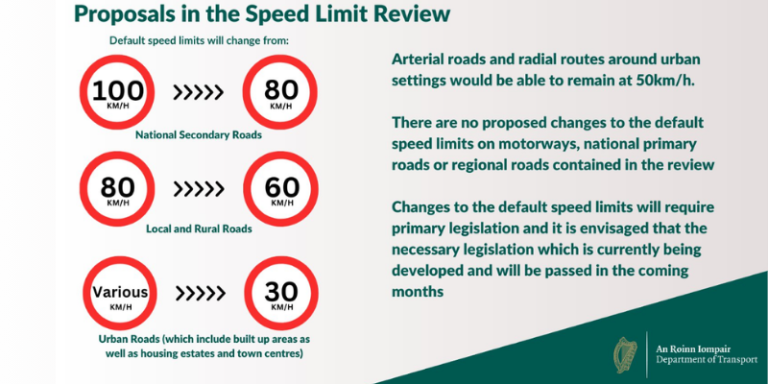
A survey carried out in November 2024 by Ipos on behalf of the RSA, with 1,200 respondents, found that on average 60% felt that the speed limit on rural Irish roads was unsafe. In February 2025 the speed limit on these roads was reduced from 80 km h to 60 km h. You can find the article here
In 2026 the government will continue to reduce speed limits on Irish roads as part of the Speed Limit Review (2023) RW-21-of-2025-Speed-Limit-Review-Implementation-Urbans-Final.pdf. This will include the reduction of speed limits in Urban centres from 50 km h to 30 km h. Some areas already have these new speed signs in place but motorists should be aware as there are no additional signage to warn of the change in speed limits. So on roads that you drive regularly you may not always have the awareness to check the limits as you drive them so often and they are and always have been 50 km h.
On zones entering busy centres (one example locally would be entering Stepaside Village) the speed signage is in the same place and we may have become blind the the actual figure but the sign is now 30 km h.
Speed limit enforcement is sure to follow in due course, so to avoid needless points and fines it is always a good idea to keep in mind that speed limits are changing and the aim is to have urban centres reduced to 30 km h by 2027. So check as you drive.
You can find more information on the new speed zones in Dublin can be found here
The three main enforcement tools you’ll encounter in Ireland are: GoSafe mobile vans, fixed roadside cameras, and average speed camera zones. Get caught by any of them, and you’re looking at a fixed charge notice, penalty points on your licence, and potentially a day in court under Irish road traffic law.
How Speed Limits Work in Ireland (So You Know What the Cameras Are Checking)
Speed cameras don’t make up the rules—they enforce them. Understanding Ireland’s speed limits means understanding exactly what cameras are monitoring.
All speed limits in Ireland are set in km/h under the Road Traffic Act 2004 and subsequent amendments. You’ll see them posted on standard circular signs with a red border and black numbers. Here’s how the default speed limit structure works:
| Road Type | Default Speed Limit |
|---|---|
| Motorways | 120 km/h |
| National roads | 100 km/h |
| Regional roads | 80 km/h |
| Rural local roads | 60 km/h (since 7 February 2025) |
| Built-up areas | 50 km/h |
| Special zones (schools, town centres, housing estates) | 30 km/h (ongoing changes) |
The big change in 2025 was the shift from 80 km/h to 60 km/h on many rural local roads. If you spot a rural speed limit sign—the white one with five diagonal black lines over a “Go Mall / Slow” plate—that now means 60 km/h on L-class roads. This significant reduction came into effect on 7 February 2025 under new guidelines from the Department of Transport.
Local authorities can also set special speed limits through bye-laws, creating lower speed limits in urban cores, near schools, or in housing estates. These reduced speed limits are designed to protect pedestrians, cyclists, and other vulnerable road users. Check the signage for urban speed limits, new speed limits etc.
One more thing: cameras check the applicable limit for your vehicle type, not just the road. Certain vehicles like heavy goods vehicles and some buses have lower limits regardless of road signage.
Types of Speed Cameras in Ireland
Speed enforcement in Ireland uses three main automated systems: fixed cameras, mobile vans, and average speed zones. All operate on behalf of An Garda Síochána, whether they’re Garda-owned or contracted through GoSafe.
The main categories include:
In-car Garda speed detection – handheld and vehicle-mounted systems
Average speed camera zones – calculate your speed over a distance. More information on static speed cameras can be found here. These are currently in operation on the M7, M2 (Meath), M3 (Cavan), N5 (Mayo) and in DPT
Fixed roadside cameras – permanent installations at high-risk locations
GoSafe mobile vans – the familiar white vans parked in enforcement zones
Irish rain doesn’t stop cameras from working, despite what your uncle insists at Christmas. The technology is designed for Irish conditions—wet, dark, and occasionally both at the same time. Nor do darker licence plates or plates that have 'special camera films'. Not only do these not work if stopped by An Garda can result in you getting points, a fine or having to get new plates.
GoSafe Mobile Speed Camera Vans
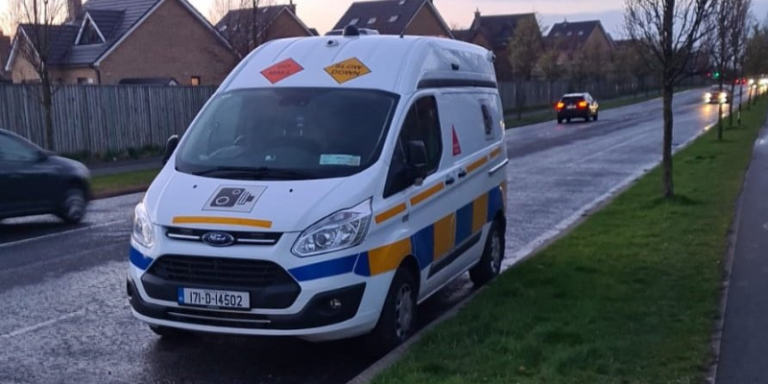
The GoSafe vans are probably what you picture when someone mentions speed cameras. They’re white vehicles with high-visibility markings, Garda and GoSafe logos, and equipment that’s far more sophisticated than it looks from the outside. Are they well liked? No. Do they reduce speeds when seen? Yes. Do they help with enforcement and save lives? Yes. If you see a flash go off passing one a night chances are you were going too fast.
Key features:
The vans use a dual-camera system. The rear-facing camera measures your vehicle speed using laser technology, while a secondary camera captures additional imagery for evidence. When your speed exceeds the posted speed limit, the system records your registration plate through ANPR (Automatic Number Plate Recognition), along with the date, time, location, and exact speed.
Van locations aren’t random. An Garda Síochána selects sites based on collision data, speed surveys, and community complaints. There are approximately 1,901 safety camera zones across the country, all publicly listed on the Garda website. Motorists who claim cameras are “hidden” might want to check that map.
Typically stationed in areas with a history of collisions or persistent speeding
Operate day and night, in most weather conditions
Capable of detecting speeding vehicles in one or both directions
Cameras and radar/laser equipment mounted inside, monitoring rear-facing traffic
Fixed Roadside Speed Cameras
Fixed cameras are permanent installations mounted on poles or gantries at specific high-risk locations. You’ll find them on busy approaches to towns, dangerous junctions, and controlled environments like tunnels. The locations were selected based on fatal and serious injury collision data from the last seven years and speed data, as well as feedback from stakeholders.
What they look like:
These cameras monitor a single point and trigger when a vehicle passes above the threshold. They’re less common than GoSafe vans but fill gaps where constant enforcement at one location makes more sense than rotating vans.
So, if you get detected exceeding the speed in these locations, what is your prize? Congratulations you get a 160 fine and 3 points. Easier to just do the posted speed.
So where are these located?
| County | Location | Speed Limit |
| Galway | N59 | 100 km h |
| Waterford | N25 | 100 km h |
| Donegal | N13 | 100 km h |
| Carlow | N80 | 100 km h |
| Dublin | Crumlin Rd(Dolphins Barn) | 50 km h |
| Mayo | N17 | 100 km h |
| Cork | N22 | 100 km h |
| Limerick | N69 | 100 km h |
Always placed where speed limit signs are clearly visible
Sometimes mounted over individual lanes on gantries
Grey or yellow box housings
Average Speed Cameras in Ireland
Average speed cameras are the ones that genuinely changed driver behaviour in Ireland. Instead of measuring instantaneous speed at one point, they calculate your average speed between two camera locations.
How they work:
This approach eliminates the “brake hard, then floor it” strategy that some drivers use around spot cameras.
Irish locations with average speed enforcement:
If your average exceeds the limit, you’re flagged for a fixed charge notice
System calculates: Distance ÷ Travel time = Average speed
Camera at Point B does the same when you pass
Camera at Point A reads your registration plate and logs the time
The Dublin Port Tunnel was Ireland’s first average speed system, installed in 2017. The M7 pilot between Junction 26 and Junction 27 was the first mainline motorway deployment, and its results were striking: speeding rates dropped from approximately 32% of traffic to under 4%.
These systems are clearly signed at entry and exit points, and the distance between gantries is fixed. The maths is straightforward, and arguing with arithmetic in court rarely ends well.
Who Runs Irish Speed Cameras and How Sites Are Chosen
Speed camera policy in Ireland involves three main players:
Camera locations aren’t selected by throwing darts at a map. The process is data-driven:
All of this feeds into the Government’s Road Safety Strategy 2021–2030, which aims for “Vision Zero”—the aspiration of zero road deaths and serious injuries. The Road Traffic Act 2024 reforms reinforced the legal framework for camera deployment as part of achieving these goals.
The 1,901 enforcement zones are reviewed periodically. Zones can be added, removed, or adjusted based on current Irish collision statistics. If a road becomes safer after engineering changes, it might come off the list. If a new problem emerges, a new zone gets added.
In short, cameras prefer dangerous bends and long straights over random lay-bys without justification.
Community feedback – local concerns about dangerous stretches
Traffic volume – roads with higher usage and risk
Speed survey data – showing regular non-compliance with posted limits
Collision history – particularly serious injuries and fatal collisions over multiple years
GoSafe – private contractor operating mobile vans under Garda direction
An Garda Síochána – responsible for enforcement
Department of Transport – sets overall road safety policy
How Irish Speed Cameras Detect and Record Offences
All speed detection equipment used in Ireland must meet strict evidential standards. This isn’t a guess—it’s measured, recorded, and documented.
Detection basics:
Irish registration plates are read automatically and cross-referenced against the National Vehicle and Driver File (NVDF) database. This links the vehicle to its registered owner within seconds.
All devices must be regularly calibrated and tested. Van operators conduct pre-shift and post-shift checks. Records are kept to stand up in Irish District Courts if someone contests a charge. Calibration certificates and operator logs become evidence if a case goes to trial.
Wet roads, darkness, bank holiday traffic—none of these prevent cameras from operating. Only technical issues, road works directly affecting a site, or policy decisions temporarily remove enforcement.
Fines, Penalty Points, and What Happens After You’re Flashed
Camera detections are processed exactly like Garda roadside detections under Irish fixed charge procedures. The system doesn’t care whether a device or a person caught you speeding.
The process:
Non-payment: increased fine and potential court summons
Payment within initial period: fixed fine + penalty points
Notice includes offence details, speed, location, and payment options
Fixed charge notice issued to registered vehicle owner
- Detection recorded and verified
- Fixed Charge Notice is issued to the registered owner
- Notice includes offence details, speed, location, and payment options
- Payment within initial period: fixed fine + penalty points
- Non-payment: increased fine and potential court summons
Current penalties (as of 2025):
Penalty points stay on your licence for three years. Accumulate 12 points (or 7 for learner drivers and novice drivers) within that period, and you’re automatically disqualified for six months.
The registered owner receives the notice, regardless of who was driving. If it wasn’t you behind the wheel, you’ll need to nominate the actual driver within the timeframe specified.
Challenging a Speed Camera Fine in Ireland
You have the right to contest any fixed charge notice. The procedure is simple: don’t pay, and the matter goes to the District Court.
In court, the Garda prosecution will typically present:
1. Testimony from GoSafe operators or Gardaí if required
2. Calibration certificates proving equipment accuracy
3. Certified camera records showing your vehicle, speed, and location
Possible defences include:
1. Genuine technical error in the detection or processing
2. Vehicle cloning (someone using plates matching yours)
3. You weren’t the driver and can prove it
What won’t work: “I didn’t see the van” or “I thought the limit was higher.” Ignorance of the law, or of a camera’s presence, isn’t a defence.
Losing in court typically means a higher fine, court costs, and potentially more penalty points than the original fixed charge. If you’re considering a challenge, get proper legal advice rather than relying on internet myths about loopholes that don’t exist.
Irish Rules on Detectors, Jammers, and Sneaky Tricks
The gadget that promises to outsmart every camera usually only outsmarts your wallet—and possibly lands you in handcuffs.
The legal position is clear:
- Penalties include fines and potential criminal prosecution
- Gardaí can seize such equipment under customs and road traffic legislation
- Using or possessing speed meter detectors or jammers is illegal in Ireland
Interfering with camera equipment or road signage—covering lenses, moving signs, spray-painting housings—is a criminal offence treated seriously by the courts.
What about apps and sat-navs that show camera locations? These exist in a different category from active jammers. Most simply display general information about enforcement zones, which isn’t illegal. However, if an app actively detects radar or laser emissions, it falls foul of the rules. Check up-to-date Irish guidance before relying on any device.
The safest and cheapest way to avoid fines remains embarrassingly simple: observe posted speed limits and adjust your speed to conditions. No gadget required.
Do Irish Speed Cameras Actually Improve Safety?
Ireland’s Road Safety Strategy 2021–2030 aims to drastically reduce road deaths and serious injuries. Speed cameras are one tool among many, but the evidence suggests they work.
The case for cameras:
- The M7 average speed pilot reduced speeding from 32% to under 4%—a behavioural shift, not just catching more people
- Road Safety Authority surveys found over one-third of motorists exceeding limits on 80 km/h and 100 km/h roads
- Excessive or inappropriate speed is a factor in roughly one-third of fatal collisions in Ireland
International research, cited by Transport Infrastructure Ireland, suggests that a 5% reduction in average speed can lead to a 30% reduction in fatal collisions. That’s because collision energy scales with the square of speed—small increases in speed dramatically increase the severity of impacts.
The 7 February 2025 change to the new speed limit of 60 km/h on many rural local roads was specifically designed to protect vulnerable road users on local rural roads where pedestrians, cyclists, and agricultural traffic mix with cars. Enforcement through cameras backs up awareness campaigns.
A balanced view:
Cameras can feel annoying when you’re running late. Nobody enjoys a fixed charge notice landing on the doormat. But fewer road fatalities and serious injuries means fewer funerals, fewer life-changing injuries, and fewer families destroyed by crashes.
That trade-off—a bit of inconvenience for genuinely safer roads—seems reasonable when you frame it that way.
Staying on the Right Side of Irish Speed Cameras
Let’s finish with some practical advice that won’t cost you a cent.
Simple tips for keeping your licence clean:
- Use your own judgement – just because a road allows 100 km/h doesn’t mean it’s safe at that speed in every situation
- Drive to conditions – the sign meant for dry daylight might be too fast in fog or rain
- Assume enforcement everywhere – any of the 1,901 zones could have a van
- Watch for updated signs – especially on rural roads since the 2025 changes, new speed limits are being rolled out in 2026 and without additional signage or notice.
- Know your defaults – 120/100/80/60/50/30 km/h depending on road type
Useful official sources:
Also you local county council will publish a map of speed limits on their websites
Garda.ie – safety camera zone maps and enforcement info
Road Safety Authority – campaigns and driver education
https://www.gov.ie/en/department-of-transport/campaigns/slower-speeds-safer-roads/ – current speed limit information
When in doubt, driving slightly under the posted limit costs you almost nothing in travel time but buys significant safety margin—especially in urban areas, near schools, or in villages where pedestrians and cyclists share the road. Watch out for new speed limits. Don't be sign blind because you drive that road everyday
Pay attention to speed limit signs when entering town centres, areas around schools, hospitals etc. These will have lower speed limits or times that lower speed limits are in operation. Around schools these times are normally 8am to 9am and from 2pm to 4pm Monday to Friday to allow children to go and leave schools with more safety. It is always important to keep in mind that there are lollipop women/men in operations as well and to reduce speed coming up to them as they may halt traffic often. And no one needs an angry lollipop person looking with utter disappointment at you while children and parents cross (they will also not only be disappointed but angry!) Cyclists should also pay attention in this area as there will be no safe way for them to navigate around as the children can be obscured from sight by cars.
So, here’s the thing: keeping your licence clean isn’t complicated. Watch your speed, pay attention to road signage, and remember that the person you’re protecting might be someone walking home from school or cycling to work. Or someone you know and love.
Fewer points, fewer fines, and less money donated to the Exchequer via fixed charges—everyone wins. Except, perhaps, the person behind you who’s convinced 80 km/h means 95. They can wait.