Changes to Irish Driving Test Rules March 2026
If you are preparing to sit your RSA practical driving test, understanding your motor insurance obligations is essential. In Ireland, valid insurance is a legal requirement for any vehicle driven on public roads, and this applies equally when you present your car at a test centre. This article explains the insurance requirements for learner drivers in Ireland, including a major rule change coming in to effect on Monday March 9th 2026 and an urgent safety recall affecting certain vehicles. We also have an important update from the RSA regarding some Citroen Cars and how the urgent safety recall is impacting some peoples ability to sit the test. Make sure you are not affected and read on for how to make sure the day of your test gets off to the best start with the new rules.
Overview of motor insurance requirements for driving tests in Ireland
In Ireland, the Road Traffic Acts require that any mechanically propelled vehicle used in a public place must be adequately covered by an approved policy of insurance. This applies whether you are driving to work, practising with a qualified driver, or sitting the RSA practical driving test. The Road Safety Authority RSA conducts driving tests nationwide, and the same insurance rules apply whether you are testing in Dublin, Cork, Galway or any other county.
From Monday 9 March 2026, specific new insurance documentation rules will apply to all vehicles presented for driving tests. These new requirements build on existing road traffic obligations and introduce stricter documentation checks at every test centre. Candidates must understand these rules in advance to avoid having their test cancelled and losing their fee.
This represents a new requirement that formalises what was previously informal guidance from driving examiners.
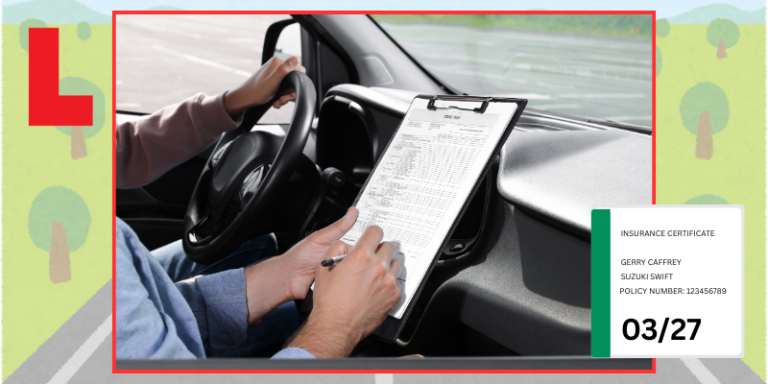
The primary document required is a valid certificate of insurance covering the date of the test and matching the vehicle registration number of the car presented at the RSA test centre. The certificate must clearly show the policy is in force on the test date.
If the candidate’s name is not printed on the certificate, which is common where the car belongs to a parent, partner, friend or works vehicle arrangement, additional documentation is required. The candidate must provide written confirmation from the insurance company stating they are insured to drive that vehicle for the purpose of the test.
This written confirmation can be an email or letter on the insurer’s headed paper. Personal details relating to other policyholders, who are not the test candidate, can be redacted, provided the candidate, vehicle registration and insurance cover are clearly identified. An email from your insurance provider confirming your named driver status is acceptable.
The driving tester will check the insurance certificate and any supplementary letter or email before conducting examinations. Documents will be returned immediately after the inspection. If you cannot produce acceptable proof that you are insured to drive the vehicle, the test cannot go ahead and you may lose your fee according to RSA terms and conditions.
General Irish motor insurance rules for learner drivers
Under Irish law, all vehicles used on public roads must be insured at least for third-party liability. This is the minimum level of cover required by the Road Traffic Acts and protects other road users against loss or damage caused by the insured vehicle.
Learner drivers must either hold their own policy in their own name or be correctly added as a named driver on someone else’s policy covering the specific car they drive. Being adequately covered means the policy explicitly permits the learner to drive the vehicle, and many insurers require this to be documented in writing.
Learner drivers in category B must display L-plates front and rear, comply with any conditions on their learner permit, and must not drive unaccompanied where the law requires a qualified driver to be present. The accompanying driver must hold a full driving licence for at least two years in the same category.
Insurers typically require accurate disclosure of the driver’s licence status, address and vehicle details. Failure to provide correct documents and accurate information can invalidate cover and make the vehicle unsuitable for an RSA test. Even if an insurance disk is displayed, an invalid policy may be treated as no insurance.
Insurance disks must be displayed on the windscreen alongside valid motor tax and NCT discs where applicable. The tester will check these disks visually before the test begins.
Vehicle eligibility and insurance checks on the day of the test
The RSA requires the vehicle presented to be roadworthy, appropriately taxed, insured and, where necessary, to have a valid NCT certificate before a driving test can start. These full requirements are published on rsa.ie and citizensinformation.ie.
The candidate must bring their learner permit in its original physical form, not a photocopy or digital version. They must also bring the insurance certificate and any supporting insurer email or letter with motor insurance confirming their cover. The car must be present outside the test centre at the appointed time.
The tester will visually confirm the insurance disc on the windscreen and cross-check documentation in the waiting room. They will verify that the registration number on the certificate matches the vehicle and that cover is valid for the test date. If there is any doubt about whether you are insured, the tester may ask questions or request additional confirmation.
If the vehicle is found to be one of the uninsured vehicles, incorrectly insured, or otherwise not compliant with RSA vehicle rules, the tester is obliged to refuse to conduct the test. This is done in the interests of safety and legal compliance. The recent industrial dispute involving the Fórsa trade union and driving examiners did not change these fundamental legal requirements, though there was a one day work stoppage during negotiations. The fresh agreement reached with Fórsa maintained the importance of compliance checks. The State Claims Agency has also expressed concerns about the risks of conducting examinations with inadequately documented vehicles.
Urgent safety recall: Citroën C3 (2008–2017) and DS 3 (2009–2019)
IMPORTANT TO KNOW: Certain Citroën C3 models manufactured between 2008 and 2017 and certain DS 3 models manufactured between 2009 and 2019 are subject to an urgent safety recall in Ireland. This recall relates to potentially defective safety components, including airbag systems, which could cause serious injury in an event such as a collision.
According to RSA and citizensinformation.ie guidance,(found here) vehicles affected by this recall cannot be used for an RSA driving test until they have been repaired and certified as safe by an approved repairer. This ban applies regardless of the vehicle’s insurance status.
The candidate must check with an authorised Citroën or DS dealer, or through the official recall lookup service using their vehicle’s VIN, whether their C3 or DS 3 is affected. Dealers can run this check and advise on next steps. The recall work is mandatory and manufacturer-funded, meaning there is no charge to the owner.
If the vehicle is on the recall list, the owner must obtain the necessary recall repair and documentation confirming completion before presenting the car for any RSA driving test appointment. Proof of repair, such as a service invoice or recall completion certificate, should be brought to the test.
The tester may refuse to conduct the test if there is evidence that an affected Citroën C3 or DS 3 has not had the mandatory recall work completed, even if the car appears roadworthy and insured. This is a safety measure intended to protect both candidates and RSA staff.
Preparing your insured vehicle for the Irish driving test
Both legal compliance and mechanical condition are required for the RSA to conduct a driving test. Candidates should prepare well in advance by reviewing the RSA Checklist for Your Driving Test, available on the RSA website, to ensure the car meets all published safety and documentation requirements before travelling to the test centre.
The vehicle must display L-plates front and rear and have fully working lights, brakes, indicators, wipers, tyres within legal tread limits, and correct mirrors and seatbelts. If any of these are defective or missing, the test cannot progress.
Candidates should confirm in advance with their insurance company that they are covered for use of the car in an RSA driving test in Ireland, especially where they are not the main policyholder. This understanding should be documented in writing if your name does not appear on the certificate.
If the usual car is temporarily unavailable, uninsured, subject to an outstanding recall, or otherwise unsuitable, candidates should arrange a fully insured alternative vehicle that meets RSA criteria before the test date. Planning ahead avoids last-minute problems that could result in losing a booking invitation and fee.
You can sign up for free email alerts from Citizens Information to stay updated on changes to insurance requirements and other driving test rules. Their website is a preferred source for official guidance.
How Gerry Caffrey Motors can help Irish drivers with insurance-ready cars
Approved used vehicles from Gerry Caffrey Motors undergo checks, servicing and diagnostics. This means customers can present a well-maintained, roadworthy car when arranging insurance or using it for practice driving before the RSA test. The team is working hard to ensure every vehicle meets the standards expected by insurers and the RSA.
The dealership can assist customers in areas like Terenure, Rathfarnham, Templeogue and surrounding parts of Dublin who need a reliable Suzuki hybrid or other model suitable for learner drivers. For those concerned about meeting the new insurance requirements coming in March 2026, having a vehicle with clear documentation and known service history makes the process simpler.
Customers planning for their first Irish driving test may wish to discuss vehicle suitability, servicing and documentation with Gerry Caffrey Motors well in advance of booking a test at a nearby RSA centre. Understanding your vehicle’s status, including any recall obligations, helps ensure you can pass the pre-test checks and focus on demonstrating your driving skills.