Car Battery Problems Ireland: Why Your Car Battery Suddenly Struggles in Autumn?
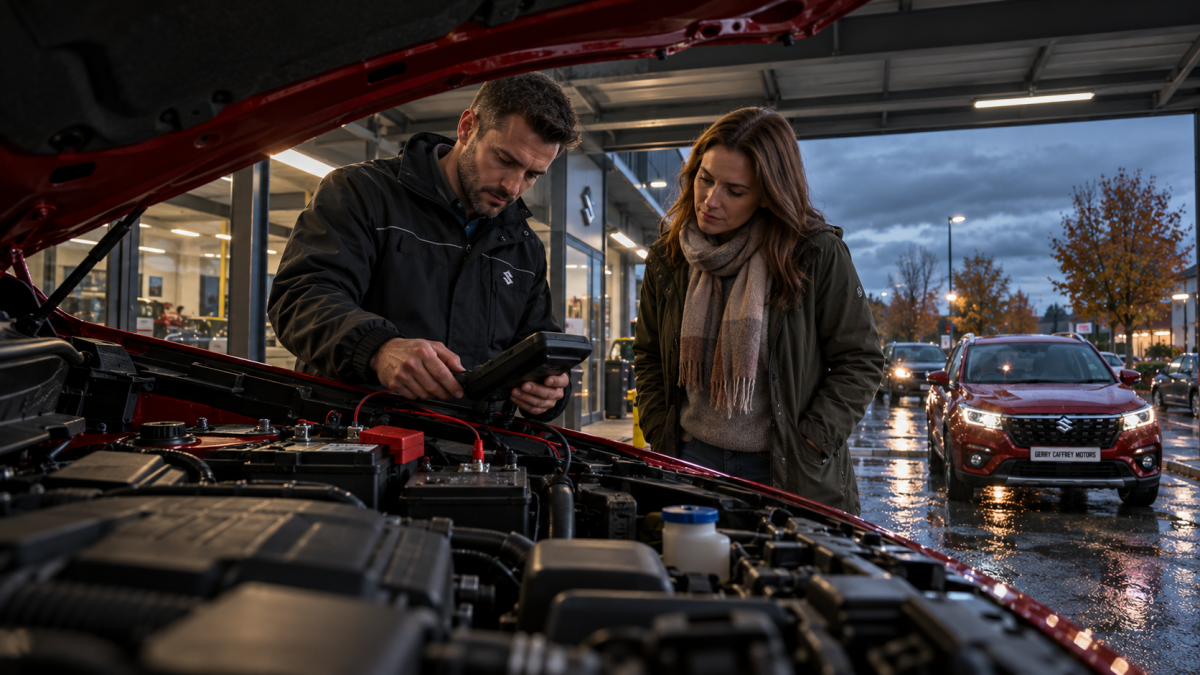
It’s one of those familiar autumn mornings in Dublin. You get into the car, turn the key or press the start button, and instead of the usual quick start, the engine sounds noticeably sluggish.
Maybe it starts after a second attempt. Maybe you hear nothing but a click.
Car battery problems Ireland drivers face are often committed to being resolved quickly, but a car battery suddenly struggling in autumn isn’t unusual. In fact, the first colder mornings of September, October and November often expose a battery that has been weakening quietly throughout the warmer months.
At Gerry Caffrey Motors in Terenure, we often see drivers assume the cold weather has suddenly damaged their battery. Usually, the reality is slightly different: colder conditions have simply revealed a problem that was already developing.
Why Does Cold Weather Affect Your Car Battery?
A conventional 12-volt car battery relies on chemical reactions to produce electrical power. As temperatures fall, those reactions become less efficient, reducing the battery’s ability to deliver the power needed to start the car's engine.
That matters in Ireland because autumn rarely arrives as a neat change of season. One week can feel relatively mild, followed by cold, damp mornings across Dublin and South Dublin.
A healthy battery should cope with that change. An ageing or partially discharged cold weather car battery may not.
Why Autumn Exposes a Weak Battery
Summer can disguise battery problems.
Starting an engine in mild conditions places less demand on the battery. Once temperatures drop, however, the battery has to work harder at exactly the same time you're beginning to use more electrical equipment.
Think about a typical October morning in Dublin. You could have your headlights on, heater running, windscreen demister working, heated rear window switched on and wipers going before you've even left your estate.
That’s considerably more electrical demand than a bright June morning.
If the battery was already losing capacity during summer, autumn can be the point when you finally notice it.
Common Battery Problems in Ireland
Moisture and damp weather in Ireland can cause a white or greenish powdery buildup on battery terminals, which is a sign of corrosion. This corrosion is often accelerated by coastal salt air and humidity, creating a challenge for car batteries to maintain good electrical contact.
Electrical drains can also occur from accessories left on or from the complex electronics in most cars, which can slowly discharge the battery if the car isn’t driven enough.
Parasitic drains happen when electronic devices continue drawing power while the car is parked, further reducing battery charge over time.
Flat batteries are typically the number-one cause of vehicle breakdowns in Ireland, especially during the winter months when snow and ice increase the risk.
Terminal corrosion can restrict current flow and cause starting issues, making it harder for the battery to deliver the necessary power.
7 Signs Your Car Battery Is Failing
Battery trouble doesn't always begin with a car that completely refuses to start. There are often warnings beforehand.
Common signs your car battery is failing include:
- The battery repeatedly needs a jump-start.
- A battery or charging-system warning light appears on the dashboard.
- Electrical equipment behaves inconsistently.
- Headlights or interior lights appear dim before the engine starts.
- Starting is noticeably worse first thing in the morning.
- You hear a clicking sound when trying to start.
- The engine turns over more slowly than usual.
Dimming dashboard lights can indicate a failing battery or alternator, which should not be ignored.
A single slow start doesn't automatically mean the battery needs replacing. But if it happens repeatedly, particularly as temperatures fall, it's worth getting the battery and charging system checked.
In our experience, catching a weakening battery early is much easier than discovering it when the car won't start on a wet Monday morning.
Is It Definitely the Battery?
Not always.
Car starting problems can have several causes, including the starter motor, alternator, loose or corroded battery connections, electrical faults or simply a battery that hasn't been sufficiently recharged.
Short journeys can be particularly relevant.
If most of your driving consists of quick school runs, supermarket trips or short commutes around Terenure, Rathgar, Rathfarnham or Templeogue, the battery may not always get enough driving time to recover fully from repeated starts and electrical use.
That's why proper diagnosis matters. Replacing a battery won't solve the problem if the underlying fault is actually elsewhere in the charging system.
How Long Should a Car Battery Last?
Car batteries typically last between 3 to 5 years, depending on several factors including battery quality, vehicle type, driving habits, mileage, temperature, electrical demand and how regularly the car is used.
Age is still an important clue. As a battery gets older, its ability to hold and deliver charge can decline.
Frequent short trips can shorten battery life because the alternator doesn't have enough time to recharge the battery fully.
Cold temperatures reduce battery performance and life, with batteries losing about 35% of their power at 0°C (32°F).
If you don't know when your battery was last changed, autumn is a sensible time to have it checked.
How to Maintain Your Battery in Winter
To minimise the risk of battery failure during the winter months, it’s advisable to charge your battery at least once a week, especially if your car is used mainly for short trips.
If your battery runs flat, you will need two things: a new one or a jump start using jump cables connected correctly — positive terminal to positive, negative terminal to negative — from another vehicle.
After jump-starting, drive for several miles to allow the battery to recharge.
Regular checks by a professional mechanic can help protect your battery’s life and performance.
Autumn Car Maintenance: What Should You Check?
Battery health should form part of your wider autumn car maintenance routine.
Irish autumn and winter driving means darker commutes, heavier rain, wet leaves, standing water and occasionally frost or ice and snow. A car that felt perfectly fine throughout summer can suddenly have several small issues become much more noticeable.
Before winter, it's sensible to check:
- Heating and demisting system
- Coolant levels (ensure the antifreeze mixture is correct to protect the engine)
- Screenwash (use a winter mix to prevent freezing)
- Wiper blades (check rubber for wear and replace if necessary; friction can reduce effectiveness)
- Exterior lights
- Tyre pressure and tread (important to determine stopping distance and safety)
- Battery condition and connections (look for corrosion or powdery buildup)
Also keep your regular servicing and NCT schedule in mind. An NCT certificate isn't a substitute for ongoing maintenance between tests.
What Should You Do If Your Car Struggles to Start?
If the engine turns slowly, don't keep trying to start it continuously.
Repeated attempts can drain what little charge remains in a weak battery. If the problem keeps returning, arrange a battery and charging-system check rather than waiting for a complete failure.
If you find your car doors or locks stuck due to cold or ice, try to stay safe by using de-icer or warm water carefully to access your vehicle.
And if you regularly rely on the car for work, school runs or longer journeys outside Dublin, dealing with a marginal battery before winter is particularly worthwhile.
Preparing Your Car for Winter Driving in Ireland
Good winter driving in Ireland starts before the first properly cold morning.
The battery is only part of the picture. Tyres become even more important on wet roads, good wipers make a major difference during heavy rain, and properly functioning lights are essential once the evenings close in.
For Dublin drivers, autumn is also a useful point in the year to ask a broader question: is your current car still reliable and economical enough for what you need?
An older vehicle with repeated starting problems, increasing repair bills or an approaching NCT may still be worth maintaining. In other cases, those costs can prompt owners to investigate the value of changing to something newer.
When Battery Problems Become Part of the Upgrade Decision
One weak battery isn't a reason to replace an otherwise good car.
But if battery trouble is just one item on a growing repair list, it's reasonable to compare the cost of keeping the vehicle with the cost of changing it.
At Gerry Caffrey Motors, we offer new Suzuki models alongside a selection of quality used vehicles.
For South Dublin driving, different Suzuki models suit different needs.
The Suzuki Swift is a compact option that's well suited to city driving, commuting and navigating busy Dublin streets.
The Suzuki Vitara offers SUV practicality for motorists who want additional space and versatility, while the Suzuki S-Cross provides another practical option for families and drivers covering longer distances.
New or Used: Which Makes Sense?
There's no universal answer.
A new Suzuki gives you the latest specification and warranty coverage, while a carefully selected premium used car can offer strong value if you want to keep the purchase price lower.
Your existing car can also form part of the calculation. A trade-in may reduce the amount you need to finance, making the jump from an ageing vehicle into something newer more manageable.
Gerry Caffrey Motors offers finance options across new and used vehicles, allowing customers to compare different ways of funding their next car.
If you're considering importing a used vehicle into Ireland, remember that VRT and Revenue requirements can affect the overall cost. Always check the latest applicable rules before making an import decision.
Don't Wait for the First Freezing Morning
Autumn battery trouble is often an early warning.
If your car is turning over more slowly, struggling after sitting overnight or repeatedly needing assistance, don't assume it'll sort itself out. Colder weather generally makes an already weak battery more obvious.
A simple battery and charging-system check can give you a much clearer picture before winter arrives.
And if reliability issues have you thinking about changing your car, compare the repair costs, trade-in value, finance options and the new or used vehicles available to you.
Thinking about upgrading to a Suzuki? Visit Gerry Caffrey Motors in Terenure, Dublin 6W. Our team can help you explore the Suzuki Swift, Vitara and S-Cross, compare new and premium used options, value your trade-in and talk through finance options.