Best Cars for a 100km Motorway Commute in Ireland
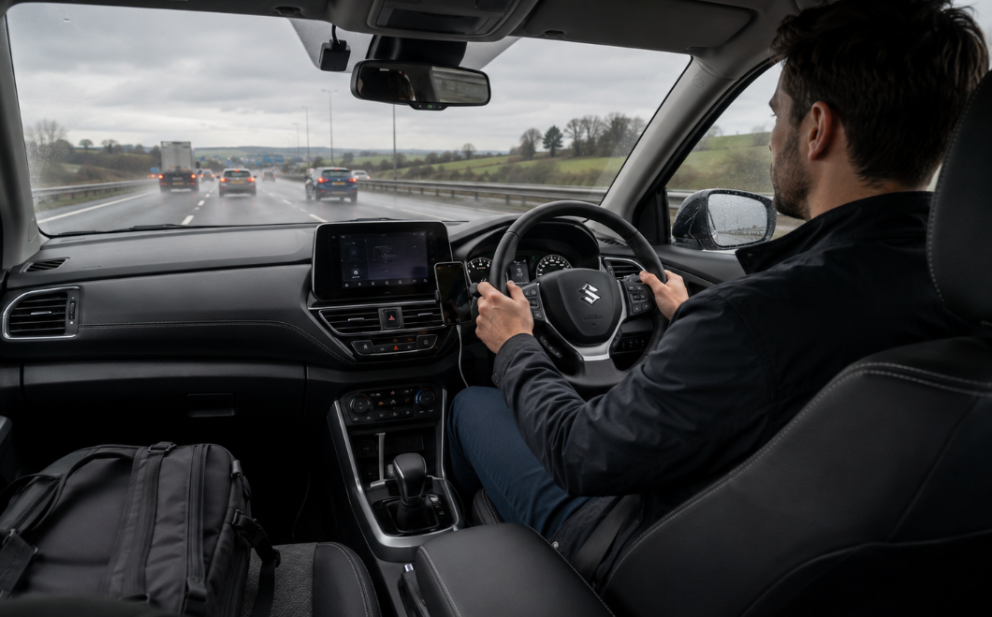
Driving 100km every working day can add more than 20,000km to your car each year. Once weekend trips and family driving are included, that figure can climb quickly.
For that kind of mileage, the best motorway cars are the ones that balance fuel economy, comfort, reliability, interior quality, motorway refinement, safety features, and reasonable servicing costs. If you are commuting long distances in Ireland, especially on daily motorway runs around Dublin, those factors will shape your fuel spend, running costs, driver fatigue, and how well the car copes with high annual mileage.
That is why the choice is not just between a hybrid, diesel car, or another engine option. You also need to compare comfort and cabin quality, engine suitability for motorway use, servicing and maintenance costs, new versus used value, and which Suzuki models, including the S-Cross, Vitara, and Swift, are best suited to long-distance driving and motorway traffic in Ireland.
What Makes a Good Motorway Commuter Car?
A car that feels comfortable on a short drive around Dublin may feel very different after an hour on the M50, M7, or N11 at motorway speeds.
For regular motorway driving, focus on the following areas.
Fuel Economy and Engine Options
Small differences in fuel consumption can have a significant effect over 20,000km or more. Diesel engines, especially those with 2.0 litre engines, remain among the most fuel efficient for sustained motorway speeds.
Official figures are useful for comparisons, but real-world economy depends on your speed, traffic, tyre pressure, weather, and driving style. Smooth acceleration and maintaining a consistent speed will generally reduce fuel use.
Diesel engines above 1.5 litre are most economical at motorway speeds, and diesel cars remain a strong option for long-distance motorway use because they can usually cover more miles per tank. For example, the Skoda Superb 2.0 TDI returns 4.8–5.4L/100km on motorways, the BMW 520d G30 has a motorway economy of 4.8–5.5L/100km, and the Skoda Octavia 2.0 TDI offers 4.9–5.5L/100km on motorway runs.
Hybrid and low emission vehicles are also advantageous for environmental sustainability and can offer excellent fuel economy. The Toyota Corolla Touring Sports Hybrid achieves 5.0–5.8L/100km on motorways, the Toyota Camry Hybrid offers 5.2–6.0L/100km on motorway runs, and the Lexus IS 300h returns 5.5–6.2L/100km at motorway speeds.
The Toyota Prius self-charging hybrid achieves close to 70mpg, while the Hyundai IONIQ hybrid can reach 60.0mpg on the motorway. In tests, the Škoda Octavia 2.0 TDI averages 68.9mpg.
Fuel-efficient vehicles can decrease the frequency of refueling stops and lower total ownership cost, not just fuel bills. A car returning 5.5L/100km can save €500–€700 annually.
The BMW 330e achieves an impressive 217.3mpg in ideal conditions, showcasing the potential of hybrid technology.
Motorway Comfort and Interior Quality
Supportive seats, especially ergonomic seats with lumbar support and heated seats, air conditioning, and a comfortable driving position are essential on a long commute. Many drivers overlook cabin comfort while focusing on engine size and fuel economy.
Well-tuned suspensions and a relaxed suspension setup are important for long-distance driving comfort, absorbing road imperfections and enhancing comfort.
Sound insulation materials reduce wind and tire noise in vehicles, contributing to a quiet cabin that minimizes fatigue during long-distance driving. Low cabin noise is essential for stress-free motorway journeys.
High-speed stability is crucial for a comfortable motorway experience. Confident handling through gentle motorway corners also reduces fatigue on a long drive. The best cars for motorway driving combine comfort and stability at high speeds.
The Skoda Superb offers rear legroom rivaling an S-Class, highlighting its exceptional interior space and roomy interior.
The Mercedes E-Class Estate, with its advanced suspension and large fuel tank, can cover over 800 miles between fill-ups, making it ideal for long-distance motorway driving.
Safety Features and Driving Techniques
Driver assistance technologies can improve safety and comfort on motorways. Features such as adaptive cruise control can significantly reduce driver fatigue.
Other useful motorway safety features include lane-departure warning, blind spot monitoring, autonomous emergency braking, and traffic-sign recognition.
Maintaining a safe distance and following the speed limit are vital to avoid accidents. Plan ahead for your exit and ease off early when approaching a slip road. Equipment varies between models and trim levels, particularly on used cars. Always check the specification of the individual vehicle, and if you need to overtake, check your mirrors and blind spots, signal clearly, and return to the left lane only when it is safe.
Servicing, Maintenance, and Running Costs
A 100km daily commute means service intervals arrive quickly, and if maintenance is neglected, high-mileage drivers will spend more on servicing and consumables over time. Factor servicing choices, tyres, motor tax, insurance, and depreciation into your budget.
When buying used, look for a complete service history and check the condition of the brakes, suspension, tyres, and windscreen. The car’s NCT history should also be reviewed.
Irish rain, potholes, and winter road grime can accelerate wear, especially on cars covering high annual mileage.
Hybrid vs Diesel for a 100km Commute
There isn’t one correct answer for every driver. The best option depends on how much of your journey is free-flowing motorway driving and how much is spent in motorway traffic or slow city driving.
Is a Hybrid Good for Motorway Driving?
A hybrid is a strong option when your journey combines motorway driving with congestion around Dublin, the M50, or busy town centres.
Suzuki mild-hybrid models use electrical assistance to support the petrol engine. There’s no need to plug them in, making them straightforward to own.
A hybrid can be particularly useful if your car also handles short local journeys, school runs, and weekend trips. It offers greater flexibility than a diesel car for mixed driving and is fuel efficient.
Are Diesel Engines Still Worth Considering?
A diesel car can still be economical if most of your mileage involves long, uninterrupted motorway journeys at or near the speed limit. They usually make the most sense when your commute is mainly steady motorway mileage rather than stop-start driving.
However, purchase price, servicing costs, emissions equipment, and running costs must be considered. Modern diesel engines are generally better suited to regular long drives and a long journey because they offer strong range between fill-ups, rather than repeated short trips.
For many Irish drivers, a petrol hybrid now offers a more practical balance between motorway economy, city driving, and long-term ownership.
Best Suzuki Cars for a 100km Motorway Commute
The Suzuki Swift, Vitara, and S-Cross suit different types of motorway commuters, from small car lovers to those needing a big car with a roomy interior.
Suzuki S-Cross: Best Overall Choice
The Suzuki S-Cross is the strongest all-round option for a long daily commute.
Its spacious cabin, elevated driving position, and practical SUV design make it comfortable on longer journeys. Hybrid options also help keep running costs under control. It’s the best fit if your daily course includes motorway miles as well as urban sections.
The S-Cross is especially suitable if your commuter car must also carry rear passengers, luggage, or family equipment. It offers good visibility and a large boot, making it a true family car.
In our experience, it offers a useful balance for many drivers travelling into Dublin from Wicklow, Kildare, or Meath. It’s comfortable on the motorway without feeling excessively large on city streets.
Suzuki Vitara: Best for Comfort and Versatility
The Suzuki Vitara is a good choice for drivers who want a compact SUV with a higher seating position.
It provides good visibility in motorway traffic and has manageable dimensions for driving and parking around Dublin. Its practical interior also makes it suitable for family use.
The Vitara feels equally at home on a motorway commute, a school run, or a weekend journey. Selected versions are equipped with Suzuki’s ALLGRIP system for drivers who want additional capability in difficult conditions.
Suzuki Swift: Best for Lower Running Costs
The Suzuki Swift is ideal for commuters who want to keep purchase and running costs significantly cheaper.
It’s light, efficient, and easy to manoeuvre when your motorway journey ends in busy South Dublin traffic. Its compact size also makes parking easier.
For one or two occupants, the Swift can be a sensible and economical commuter car. However, drivers who regularly carry rear passengers or luggage may prefer the additional space of the Vitara or S-Cross.
We recommend taking the Swift on a proper motorway test drive before deciding. Many drivers enjoy its light and agile character, while others prefer the higher seating position of an SUV.
New vs Used for a High-Mileage Commute
A new car provides the latest safety equipment, warranty protection, and predictable early ownership costs. It can make sense if you intend to keep the car for several years.
A premium used car can reduce the initial purchase price and offer better value. There are often well-kept motorway-oriented models for sale on the used market, but history matters more than headline price. Condition and service history are more important than simply choosing the cheapest vehicle available.
When buying a used commuter car, check:
- Warranty coverage
- Number of keys
- Windscreen condition
- NCT history and expiry date
- Brake and suspension condition
- Tyre condition and tread depth
- Complete service history
In our experience, a well-prepared used Suzuki is often a better investment than a higher-spec car with an unclear history.
Choosing the Right Commuter Car
Before making your decision, consider:
- Whether you prefer a hatchback or SUV driving position
- Your servicing and fuel budget
- How many passengers you usually carry
- Your total annual mileage and route
- How often you encounter heavy traffic or slow traffic
- How much of the journey is motorway driving
The most economical car on paper isn’t always the best car for your daily routine. It should also be comfortable, dependable, and affordable to maintain.
For lower running costs, consider the Suzuki Swift. For additional comfort and versatility, the Suzuki Vitara is a strong choice. For the best overall combination of space, refinement, and motorway ability, look at the Suzuki S-Cross.
Thinking about upgrading to a Suzuki? Visit Gerry Caffrey Motors in Terenure, Dublin 6W, to compare the Swift, Vitara, and S-Cross, discuss finance and trade-in options, and arrange a test drive.
Additional Considerations for Motorway Driving
Many drivers worry about overtaking safely and merging from a slip road. Choosing a car with an automatic gearbox can make these maneuvers easier and less stressful.
Keeping a safe distance and obeying the speed limit are key to avoiding accidents, especially in heavy traffic or adverse weather. If you miss your exit, continue safely and leave at the next slip road rather than making a late lane change.
For those interested in alternatives, models like the Skoda Octavia or VW Golf offer excellent motorway economy and a roomy interior, often at a significantly cheaper price on the used car market, and the Octavia also stands out for exceptional boot space and economy of 4.9–5.5L/100km. If you choose an electric car for a long journey, check charging stops in advance because top-ups can add hours and real-world range on a single charge matters.
Toyota's hybrid models, including the Corolla Touring Sports estate model, are also well equipped for long-distance driving with good visibility, comfortable seats, and a large boot.
Ultimately, the best motorway cars balance fuel efficiency, comfort, safety, and practicality to suit your specific needs and life situation.